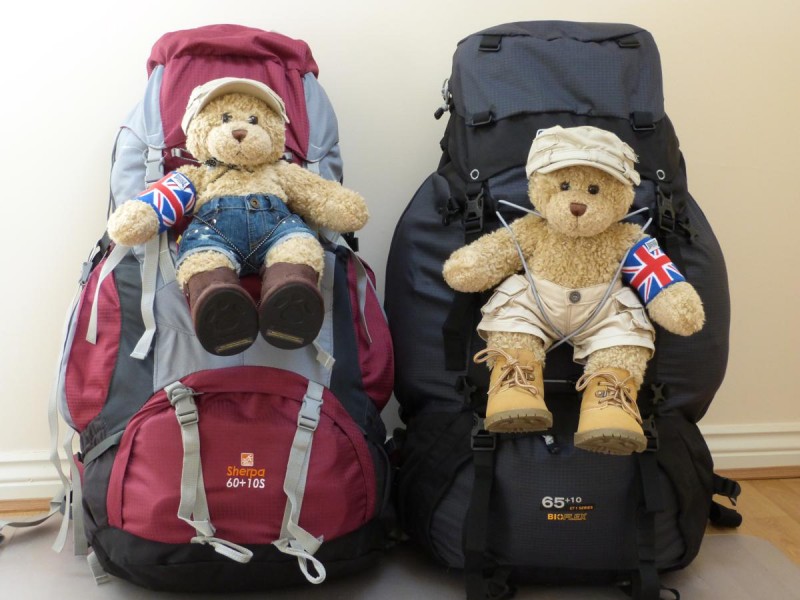
Golden Northern Triangle Tour … And a selection of the 901 pics!!!!!!!!
This week we are embarking on our 7 day tour of Delhi … Agra … Karauli … Jaipur … Delhi
Sun 23rd September – New Delhi, Pooja Palace Hotel
Today, we leave the magical Taj Lake Palace Hotel. Whilst sitting in reception, quietly reflecting on our visit, Prateet brings us gifts as a momento of our stay here – and we are grateful.
All the rest and relaxation of the last few days disappears on our arrival at the airport in New Delhi when we take our first taxi ride across the City!!!!! Hair-raising doesn’t cover it. We hold on for dear life – even N was worried. The bags are on the roof and, as we go around each and every island on what seems like two wheels, we have visions of peering out of the rear window to find our belongings strewn all over the road! However, we eventually make it to the hotel, catch up with folks back home to say we’ve arrived safely (pmsl) and prepare for the tour we are joining tomorrow.
Mon, 24th September – New Delhi, Pooja Palace Hotel
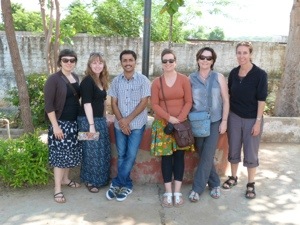
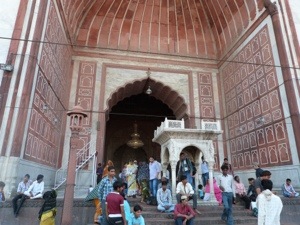
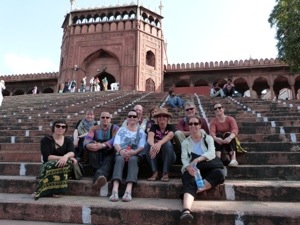
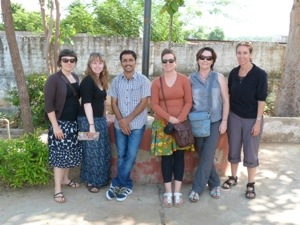
We attend our mid-day meeting and meet our Group Leader, Bhupinder Singh and the rest of our group – John & Leonie, Deb & Steve, Elana, Jenny, Tiffany & Kate. We kickstart the adventure by delving into Delhi’s chaotic medley of bazaars, temples, mosques and colonial buildings. On route to our first temple – the Red Temple (Muslim and the largest in Delhi), we weave through a maze of cars, rickhaws and bullock carts and experience fast paced city life – London doesn’t even touch this 🙂

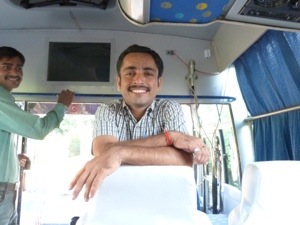
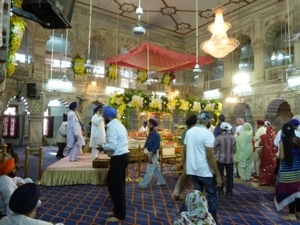
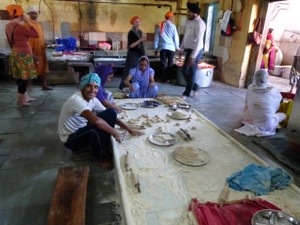
We then walk to a Sikh Temple and participate in prayer which was a very funky affair with three musicians playing. It was being filmed and we were informed that this goes out live every day across the tv network. We take a tour of the rooms at the back where they cook and feed 22-25000 people a day, no matter what creed, colour or religion! Amazing and very humbling!
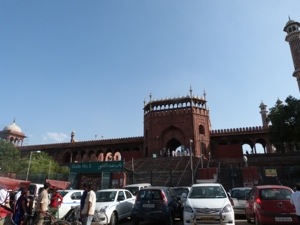
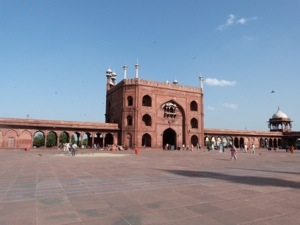
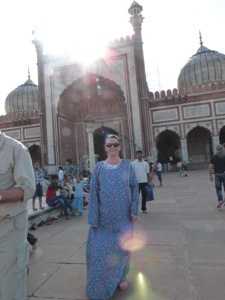

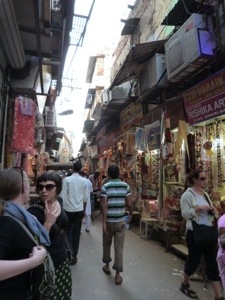
As we walk back we once again experience the noisy, busy streets … many people, like a huge ants’ nest, constantly moving … you must move or get left behind! Nothing stands still for long. This country just buzzes with life from every corner!
Once back at the hotel we prepare our rucksacks for the next few days travel and fall into bed for a 5.00 am start.
Tue, 25th September – Agra, Pushp Villa
We let the ‘train take the strain’ to journey to Agra, a former Mughal Capital that is home to some of the Country’s most iconic landmarks – we discover the halls of the Red Fort -the largest fort in Asia, it’s mosques, chambers and gardens during the morning and in the afternoon admire the Taj Mahal’s intricate carvings.
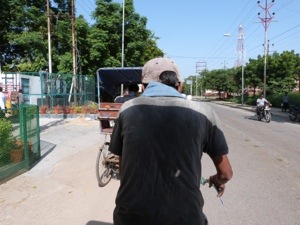
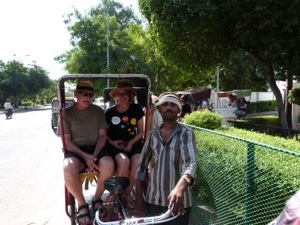
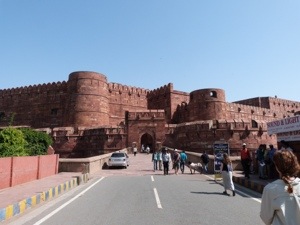
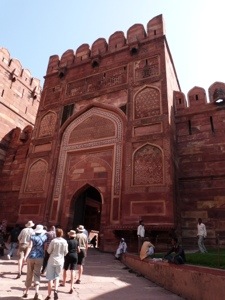
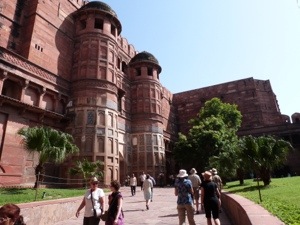
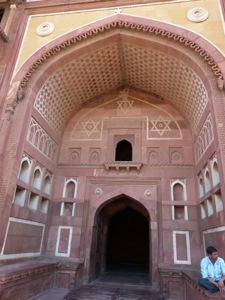
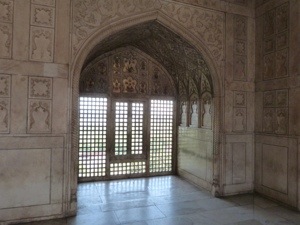
Our mode of transport around the City is by Rick Shaw stopping first at the Red Fort. This is a beautiful place full of history. The buildings, as we are going to learn over the next few days, are quite unique for their time. In addition to beauty, they are fully equipped with air con, heating, lighting and audio! The cavity in the walls was filled with either cold or hot water to cool or warm the room accordingly – the steam or cold air would come out through the ornate grills lining the rooms. The rooms were built to allow as much cool breeze as possible throughout the Fort. Windows and ornate grills provided lighting and rooms were built with tall domed ceilings to allow for audio. This really would have been a splendid residence in it’s day and you can conjure up beautiful images of life here. It’s here that we get our first views of the Taj Mahal in the distance.
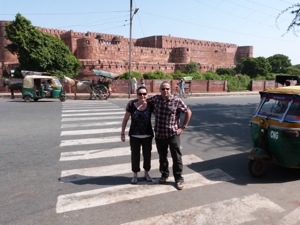
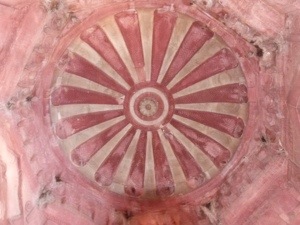
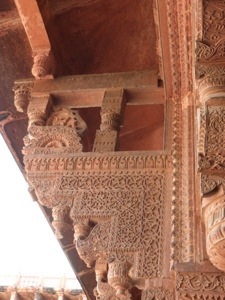
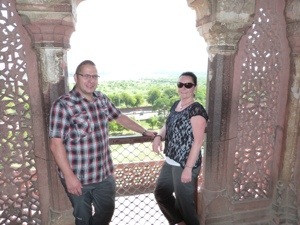

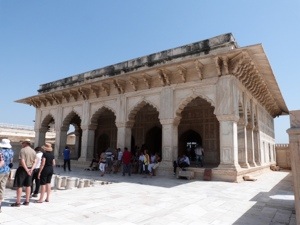
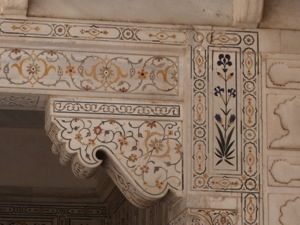
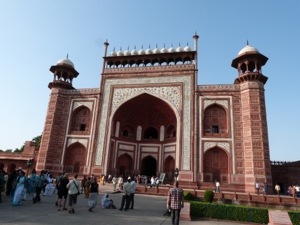
In this tourist area we are accosted by street sellers – they appear from everywhere! N is far better than I am at dealing with these people but, despite trying to obey Bhupy’s instructions not to engage, before you know it he is buying a book on the Taj Mahal for 100 IR. Once through security, we are faced with the marble beauty that is the Taj Mahal. Again, we have no words – it is overwhelming. At first we stand in awe and digest that we are actually here.
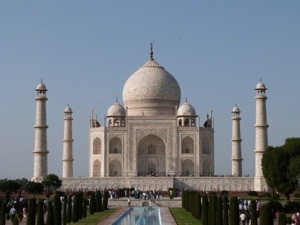
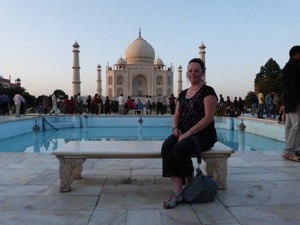
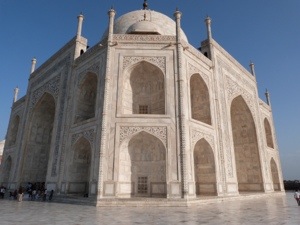
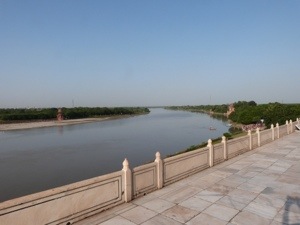

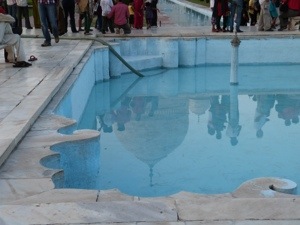
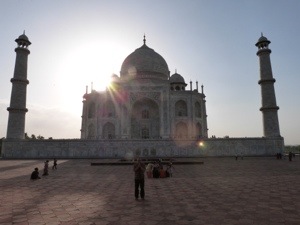
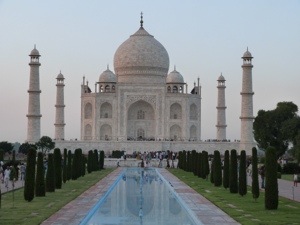
Taj, aptly called a Dream in Marble is situated on the right banks of the Yamuna River. Taj Mahal, the most beautiful building in the world is made of white marble in the loving memory of the then Empress of India – named Arjumand Bano Begum. Born on 6th April 1591, she was Persian in blood and very beautiful. Her father, Khwaja Abul Hasan (brother of Noor Jahan, Prime Minister of Jahangir’s Court, arranged for her education in a royal manner and she developed in all her qualities and merits of a royal family. She attracted the attention of Prince Khurram and they fell in love. Shahjahan and Mumtaz Mahal were inseparable lovers and, after giving birth to their 14th child she became seriously ill. It is said that at the time of her death, Mumtaz Mahal expressed her last wish to the Royal Emperor Shahjahan that he build a beautiful and incomparable monument over her grave as a token of their worldly inseparable love.
After her death Mumtaz Mahal was given a temporary burial (amanat) at Zainabad on 15th June 1631. It wasn’t until December 1631 that her body was sent to Agra and was again buried temporarily in the north west corner of the garden on the bank of the River Yamuna. It was here that the Emperor announced a memorial to be built for his dear wife and invited designs from famous architects of the world. So many designs were put before the Emperor but ultimately the design of Ustad Isa Afandi of Turkey was selected and the construction of the Taj was started.
We leave this place as the sun starts to set and the building takes on a rose coloured tinge. Once back at the hotel, the group met on the rooftop terrace for food and drink and a lovely couple of hours were spent getting to know each other better and reflecting on our first day. A lovely end to an amazing day.
Wed, 26th September – Karauli, Bhanwar Vilas Palace(a heritage property)
A 7.30 am start takes us to Karauli. En route, we visit the red limestone Mughal Kingdom in Fatehpur Sikri, a perfectly preserved ghost town. Although the mosque here remains active, the village is abandoned. Sarajan Singh, builder of the Red Fort, Agra, also built this place – taking 12 years to construct, he lived in it for only 40 before he abandoned it. He no longer needed it and had proved himself in his architecture.
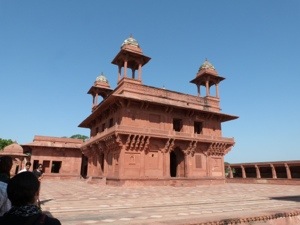
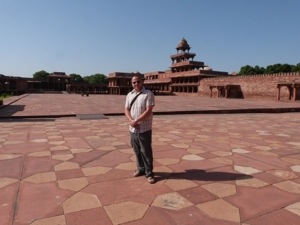
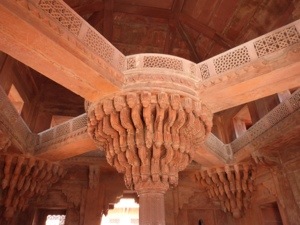
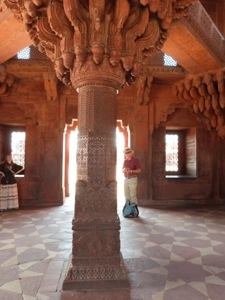
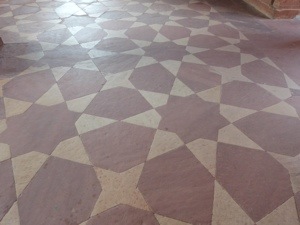
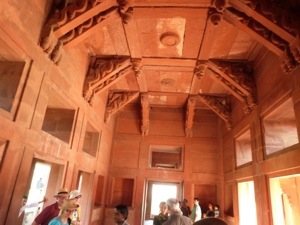


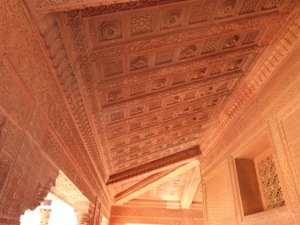
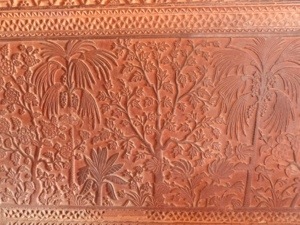
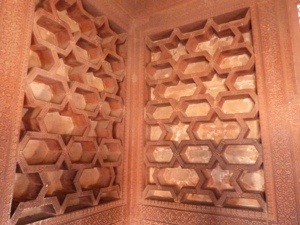
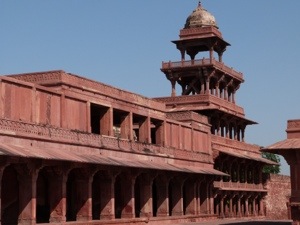
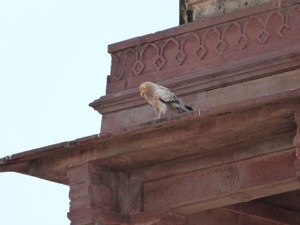
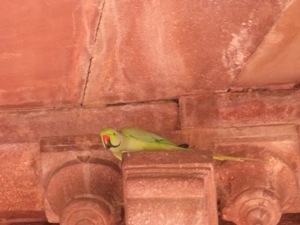
In the grounds of the Red Fort is a monument to the elephant owned by Sarajan Singh and which was used in acts of ‘capital punishment’. The convict was tied to a rock (still visible today) and the alcohol fuelled elephant was released and would stamp on the person until he was dead! At the mosque here is a marble temple, tomb of Salim Chasti, and legend has it that you can make a wish here (tying a piece of string to the grill as you do so) and, should it come true, you must come back, take your string and dispose of it in the river.

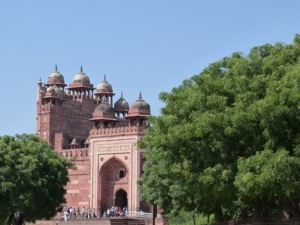
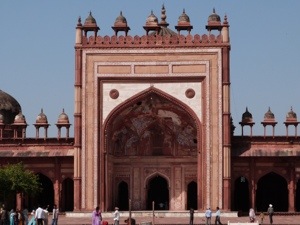
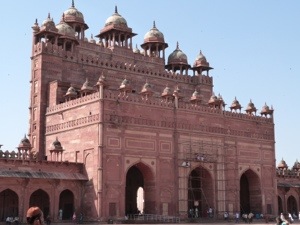
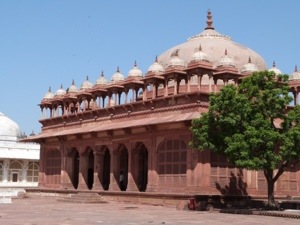
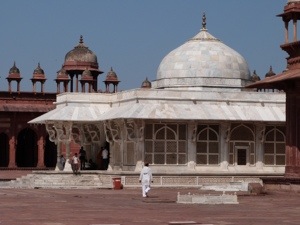
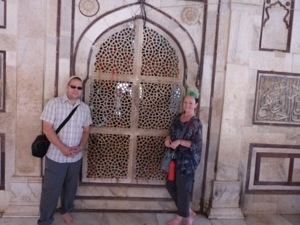
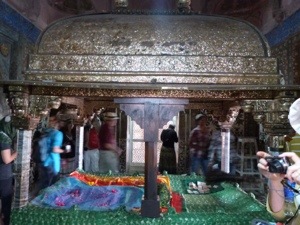
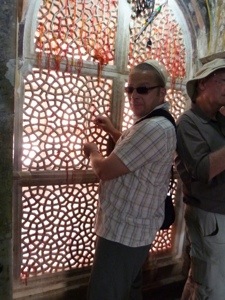
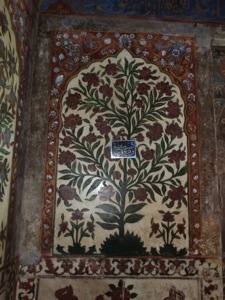
Outside there are lots of street vendors who are very persistent. We are learning to ignore them but I for one feel really impolite, especially to the children. Anyway, N comes away with a travel chess set.
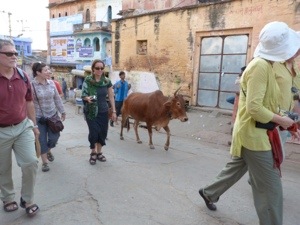
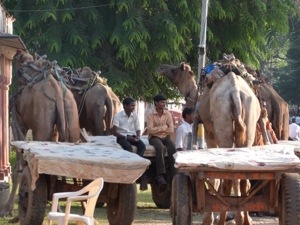
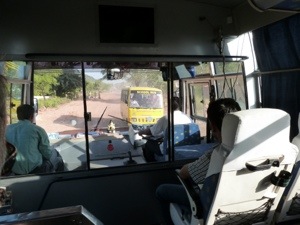
It is 4 hours by bus to Karauli and we view a myriad of life as we travel along … there is an abundance of life here in India and people work so hard for seemingly so little. However, there is much colour here and mostly happiness. The sacred cow has right of way here amongst the constant horns of the lorries, buses (packed with people), rick shaws and bikes. There are animals everywhere … camels, horses and elephants being used for labour … pigs, dogs cows that line the streets … buffalo being moved around … monkeys on rooftops There is also an abundance of retailers at the side of the roads … and the houses are full to the brim with families.
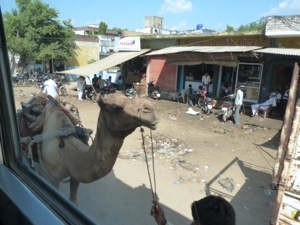
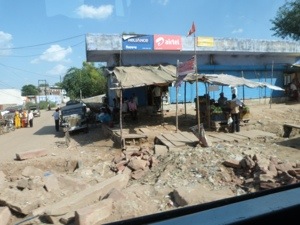
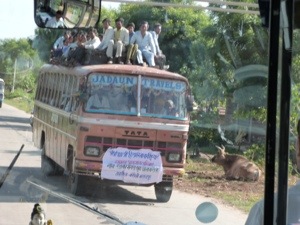
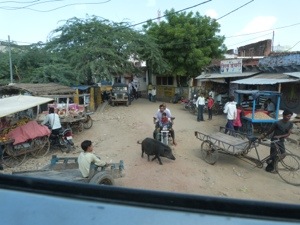
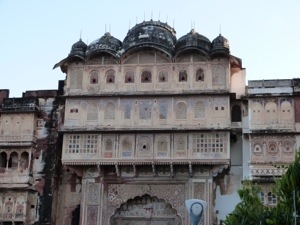
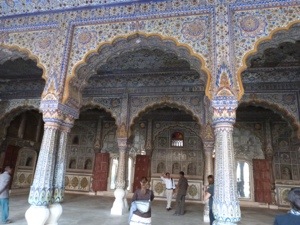
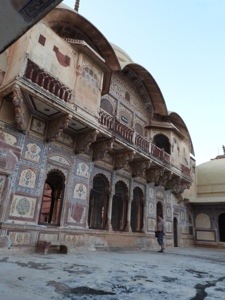
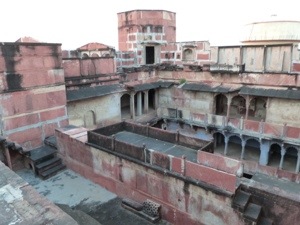
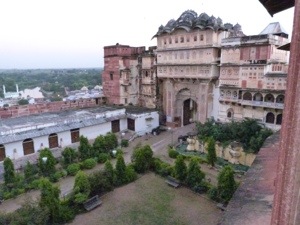
Now in the countryside, we arrive at Bhanwar Vilas Palace, a member of Indian Heritage Hotels Association and India’s Royal Legacy, just to check into our rooms before heading off through the village, and see how he current of life bubbles along in rural India. We walk through the old and new town to the 600 year old Karauli City Palace, built in the 14th century by the royal family. The City Palace is a treasure trove of architecture, stone carvings, gorgeous jali work, glass inlay work, classic paintings with ornamented stucco work and frescoes. The Palace also has an old Temple of Shri Madan Mohanji, the deity of Lord Krishna, worshipped by millions of followers from Rajasthan and the rest of India. It is now in the hands of the Temple Trust since the royal family could not afford the upkeep nor did they wish to damage the property in order to modernise it. This was quite a unique visit to a City Palace in that we were escorted through every nook and cranny here and nowhere was roped off – we went everywhere! It was very splendid how these people lived – everything was in the Palaces i.e: in-house parliament and house of commons, areas for dancing and entertainment, many bedrooms for the many many wives, ornate grills behind which the women viewed everything, gardens, playrooms. Throughout there is evidence of both Hindu and Muslim religions.
We were guided higher and higher to more rooms until eventually we came out on top of the building and the views of Karauli were amazing as the sun sets.
The Temple here is still in use today and we join a prayer service. This is more like a party celebration – there is much singing, dancing and it is very colourful. The service lasts 10-15 minutes and locals come everyday, some more than once a day.
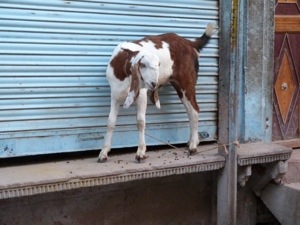
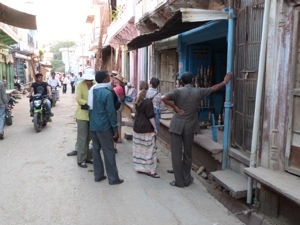
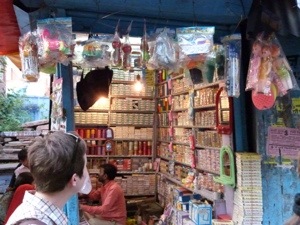
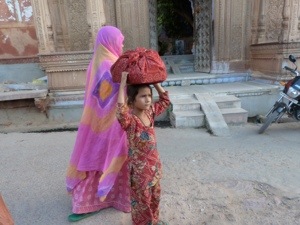
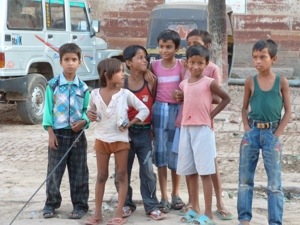
Our walk back through Karauli was at 6pm in the dark and once again it is a pleasant experience – not reliant on the tourist industry here we are not harassed by people begging or selling. The streets are lined with local craftsmen and it is busy with vehicles and animals along the way. It seems that the locals are more interested in us as we walk by, the children especially.


Thu, 27th September – Jaipur, Hotel Khandwa Haveli (a heritage property)
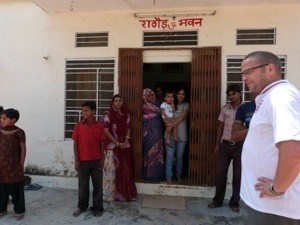
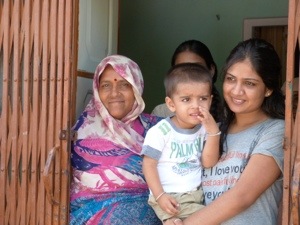
A 7.00 am buffet breakfast starts our day and we get on the minibus (for another 4 hours!) at 7.30 am to make our way to Jaipur, the pink city. En route we call into Bhupy’s mother in law’s house for a cup of tea and a biscuit. Here we meet his wife and son, Hunny (a real cutie at 2 1/2 years old). Their hospitality is great and Hunny is very astounded by our visit. It wasn’t long before news of our visit spread to neighbours who began filing past the house to see ‘these westerners’. Photos were taken and good wishes exchanged before be moved on.

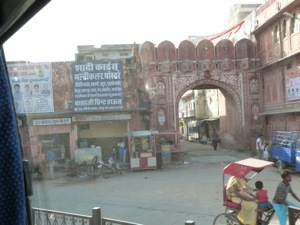
As in other areas of India, Jaipur has an Old and New City. In 1727, Maharajah Jai Singh commenced building a new capital south of Amber and named it Jaipur – City of Victory. It was one of the very first planned cities and was once enclosed within fortified walls 20ft high and guarded by 7 gates. Designed by a Bengali engineer, Vidyadhar Bhatta Charya, it took 6 years to build the main Palaces and roads and was surrounded by high walls and 7 gates. It is 9km sq which is in accordance with ancient Hindu architecture called Shilpa Shastra, symbolising the nine divisions of the universe through nine rectangle sectors called Chaukris. The city complex in the middle is symbolic of Mt Meru.
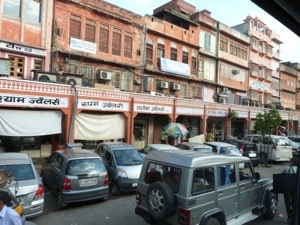
Jaipur is also known as the Pink City. This is a traditional colour of welcome and was used in 1853 by Maharaja Man Singh II in honour of the visit of Prince Albert, Prince of Wales, to Rajasthan. The capital of Rajasthan, surrounded by the Aravalli range of hills, Jaipur is situated in the heart of the Thar Desert.
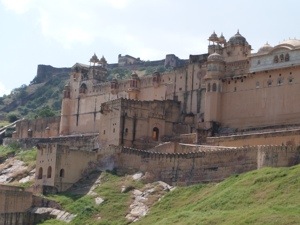
Once in Jaipur, we can see why the City’s pink sandstone streets make this city a colourful destination. The impressive Amber Fort and Amber Palace are next on our tour – a complex started by Raja Man Singh, a noted Rajput General in Akbar’s army in 1600. 28 kings have ruled here in 6 centuries.

Fri, 28th September – Jaipur, Hotel Khandwa Haveli (a heritage property)
FREE Day 🙂
We meet with group at 9.00 am so that Bhupi can escort us all down to City Palace, whilst showing us places of interest along the way including where to take lunch. We pair up with John and Leonie and decide to take ourselves on a relaxing tour of Jaipur’s City Palace and the Observatory (Jantar Mantar).
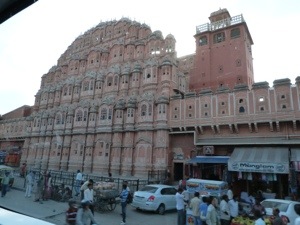
The Palace was home to the rulers of Jaipur since the first half of the 18th Century. The current Maharaja still lives in part of the 1500 room complex. It contains a fine collection of buildings and museums, a blend of Rajput and Mughal architecture. The Textile and Costume, the Armory Museum and the Art Gallery are particularly impressive. The ‘Palace of the Winds’ forms part of the east wall of the City Palace complex. The elaborately carved facade enabled the purdah ladies in the zenana to watch the goings on in the street below without being seen.
The palace, like others before is beautifully created, but here it is coloured pink which is quite pretty to see. Again, there is evidence of stunning architecture and of the affluence of the royal family’s residence at the time.
The observatory, one of 5 constructed by Maharajah Jai Singh II who had a fascination for maths and science, was built between 1728 and 1734. It contains 17 astrological instruments each of which serves a particular function. It was quite something to behold and it’s quite amazing how, at that time, these instruments were constructed.
An Auto Rickshaw or Tuk Tuk as they are locally known, was the chosen transport for our journey to Jaigarth Fort, ‘Victory Fort’, a steep 30min drive from Amber. Once used as a treasury of the Kachwahas it is still believed that some of the royal treasure is buried within its walls. One of the few surviving cannon foundries is here as can the 50 ton Jaivana Cannon, cast in 1720, the largest wheels cannon in the world. Despite its size the cannon has never been fired. Nor has the Fort been penetrated as its defence systems and location meant that enemies never dare enter it. This is very clear to see, indeed how it would have been constructed is amazing! Rising above everything in the surrounding area, there are amazing views of the stunning scenery (Aravalli range of hills), Jaipur and it’s fortified walls as well as Amber Fort and Palace. Beautiful!
Sat, 29th September – back at Pooja Palace Hotel
Said to be the most beautiful cinema in Asia, the group decided to take in a Bollywood movie at Raj Mandir Cinema, Jaipur. It is actually like our theatres back in the UK but there is no denying that it is really pretty. We watched Barfi, a slapstick romantic comedy without subtitles(!) which was very easy to follow and most enjoyable. This was an experience with audience participation.
A 4 hour train journey took us back to New Delhi in the company of 120 schoolgirls who had been out on a day trip themselves. They were very chatty and quite taken in by us westerners and took plenty of photos of us! It took us an age to get out of the traffic at the station and everybody was shattered on our arrival at Pooja Palace at 11.00 pm. We said our goodbyes and made our way wearily to bed. We really didn’t envy those in the group with early starts to their onward travel!
Sun, 30th September – Thu, 4th October – Maidens Hotel, Old Delhi
After the regime of the tour, we had a lazy morning and headed off to our next destination, Maidens Hotel in Old Delhi. Imagine our delight at checking into this stunning place – our suite was a welcome change as was the outdoor swimming pool 🙂 needless to say we just couldn’t wait to jump straight in and we did just that. We also lazed around on Monday and planned a day out for Tuesday.
Tue, 2nd October – Having hired a driver for the day (8hrs for 2500 IR) set off with our packed lunches at 9.00 am and visited the following sites:-
Red Fort (Lal Quila) – a masterpiece of architecture situated in Old Delhi. Situated opposite Jama Masjid – Delhi’s biggest mosque, the fort built in 1638 is enclosed within red sandstone walls, from which it derives its name. Its walls rise 33m above Old Delhi and serves as a reminder of the magnificent power and pomp of the Mughal emperors. The main gate, Lahore Gate, is one of the emotional and symbolic points of the modern Indian nation and attracts a major crowd on each Independence Day. As you enter the fort compound, you pass through the vaulted arcade of Chatta Chowk, a bazaar selling tourist trinkets. Inside is a treasure trove of buildings, including the Drum House, the Hall of Public Audiences, the white marble building of Private Audiences, the Pearl Mosque, Royal Baths and Palace of Colour. The Red Fort also houses the famous archaeological museum.
Qutab Minar – Immediately after the defeat of Delhi’s last Hindu Kingdom, Qutb-ud-Din Aibak laid the foundation of this world famous Minar in 1193. He only succeeded in raising the first storey – the remaining storeys being completed by his successors. A soaring stone tower of victory, 72 metres high, it has 5 distinct storeys each with a projecting balcony and is ornamented by bands of inscriptions. Made of red sandstone and marble, the base of the Minar is 15m in diameter and the top just 2.5m in diameter, an amazing piece of work. Some believe that the Minar was erected as a tower of victory to signify the beginning of the Muslim rule in India.
At its base is Quwwat-ul Islam Mosque, constructed in 1197 it was the first mosque to be built in India. Even though in ruins, this is one of the most magnificent structures in the world. The main mosque comprises of an inner and outer courtyard, decorated with shafts and surrounded by pillars. Most of the shafts are from the 27 Hindu temples which were plundered to construct the mosque and an inscription over its eastern gate provocatively informs that it was built with material obtained from demolishing them. It is therefore not surprising that the Muslim mosque has typical Hindu ornamentation. The Iron Pillar, one of Dehli’s most curious antiques, is a 7m high iron pillar (4th Century) which stands prominently in the courtyard of the mosque.
Humayan’s Tomb – This magnificent garden tomb is the first substantial example of Mughal architecture in India characterised by high arches and a double dome. Built in 1565, nine years after the death of Humayun, by his senior widow Hamida Begam, inside the walled enclosure are the most notable features of the garden squares (chaharbagh) with pathways and water channels. Centrally located is the well proportioned mausoleum and the design represents the first ‘tomb in a garden’ complex in India. There are several graves of Mughal rulers located inside the walled enclosure and from here in 1857 Lieutenant Hudson had captured the last Mughal emperor, Bahadur Shah II.
Swaminarayan Akshardham – This temple epitomises 10,000 years of Indian Culture in all its breath taking grandeur, beauty, wisdom and bliss. Built in only 5 years it showcases the essence of India’s ancient architecture, traditions and timeless spiritual messages. The Akshardham experience is an enlightening journey through India’s glorious art, values and contributions for the progress, happiness and harmony of mankind. A culmination of colossal devotional efforts of 11,000 artisans and thousands of volunteers and is heralded by the Guinness World Record as the World’s Largest Comprehensive Hindu Temple and the complex was inaugurated on 6th November 2005.
In the evening there is a musical fountain show that depicts the cycle of birth, life and death as described in India philosophy.
This place was quite beautiful – every piece of stone was sculpted. Despite the breathtaking architecture we had already witnessed in India, this young place was high up on our list for it’s workmanship. It really astounded us.
During the day we also took a ‘drive by’ of :-
Parliament House – this circular colonnaded building has housed the Indian Parliament since 1947. Designed by Sir Herbert Baker, it was in this building that the Constituent Assembly sat for 3 years to prepare the Constitution of free India.
President House – current home of the President. It is a national holiday today and many locals were visiting the area. There was also a small regiment visiting today and they were extremely enamoured with us, lol. We were taking photos of the buildings and they were asking to take pictures of us – bizarre but funny!
India Gate – a war memorial arch, was built in honour of 90,000 Indian Soldiers who lost their lives in World War I. Below it burns the Amar Javan Jyoti, the eternal flame intribute to all martyred soldiers of India.
Lotus Temple –
HAPPY DAYZZZ …. 100IR = £1.15 🙂
 Pitkins Around The World
that’s great…..have fun 🙂